Together we can make a difference!
Never doubt that a small group of thoughtful, committed individuals can change the world; indeed it's the only thing that ever has. – Margaret Meade
We are looking for parents, teachers, and students who support advanced and gifted education for Rochester Community Schools in Michigan. Please subscribe to Rochester SAGE to receive updates.
Also, please visit the "How to Help" link in the upper right.
Avondale GATE Magnet School Info Night

Avondale GATE Magnet School meets the academic, social, and emotional needs of gifted learners. The only gifted public school in Oakland County, Avondale GATE has grown rapidly the past three years as families have discovered how its unique environment and curriculum works for student happiness, success, and vital skills development.
My own daughter is in her third year at Avondale GATE and no longer feels out of place at school. She has academics at her level and pace, friends in her class with similar interest and abilities, and is learning how to work hard, overcome obstacles, and recover from failure. Through project-based learning and passion projects, she has been able to explore and educate her classmates on topics such as wi-fi and knitting, areas she chose to learn about.
If you are interested in learning more about Avondale GATE Magnet school – or just curious – Information Nights are on January 29 and February 5 from 6:30 PM to 7:30 PM at Meadows Learning Center. More information is available at AvondaleGATE.org or post a comment below. I hope to see you there!
Last Chance for CHAMP
Last chance for CHAMP!

Into the Gifted Classroom
“It’s too hard!”
My daughter, Claire, was having a meltdown over math again. She hated math, but I knew it wasn’t too hard for her. She did extremely well in it and her only competition was a boy in her class.
“When you say it is hard, do you mean it is boring?”
“Yes, it is boring!”
“Why is it boring?”
“I already know it!!!”
This was true. She had a natural knack for understanding math, even though she struggled with learning her multiplication tables. In our math discussions at dinner (yes, we are nerds), she held her own quite well against her sisters three and five years older than her, who are no math slouches.
Some people think gifted students are thrilled with easy schoolwork and homework. What’s not to love about getting straight As without effort? Instead, most gifted students are frustrated at the missed opportunities for learning. It is when they have given up on school that gaming the system to get As becomes the most thrilling part of education.
What to do? Well, after so many promises about differentiation, a full year’s growth, Multi-Tier Systems of Support for high ability students, curriculum that would challenge all students, and other help for gifted learners, we knew that our school district would never provide what our gifted daughters needed. Either they don’t understand gifted learners or they are unwilling to make the changes to meet their needs.
It was time for something drastic. It was time to break from our district to start a program.
 We first explored a charter school, but we had neither the money ($250,000) nor expertise to start one. We began to look around at districts to partner with to create a school. We were immediately attracted to Avondale. Avondale offered innovative leadership, a diverse population, and an excellent location. Innovative leadership was vital as even great districts can get stuck in a rut and only be willing to do minor tweaks; this was major. A diverse population was important to us as we don’t believe gifted education should only be for wealthier white families, a problem that often occurs nationally. Located at the intersection of two highways meant easy travel for School of Choice students, who would make this program feasible for the district.
But how would Avondale respond? We came out of our first meeting absolutely astonished! After years of being told “no”, “wait”, “we don’t see a need”, or “we have no money” or just given the cold shoulder in our district, we were warmly welcomed, they recognized the need, and they wanted to explore moving forward with a gifted program. As we walked to the parking lot we were shocked and jubilant!
In the fall of 2017, the Avondale Gifted Magnet Program opened and we enrolled our youngest daughter in third grade there. Even though I had been involved in starting the program, I was nervous. I knew the administration at Avondale had done a tremendous amount of work, studied giftedness, and found excellent teachers, but what would it be like? Would the teachers differentiate well or would we still have to push? Would it be just a standard classroom filled with really smart kids, as honors and AP classes often are? And what the heck was this Project-Based Learning that they kept talking about?
Astonishing. Breathtaking. Miraculous. It exceeded our expectations by leaps and bounds.
The teachers tested the kids to find out where they should be. Our third grader was placed in fourth grade math and started on eighth grade level books with kids of similar ability. A few weeks later, our daughter’s teacher contacted us about moving her up to fifth grade math. We were a bit dumbfounded! This never happened in our home district! She’s been doing great in fifth grade math, but now when she says “It’s too hard!”, it means that she actually has to put in effort to succeed. Yes! Sadly, her friend in her prior class has not received the acceleration he needs.
Science appears to be a subject she really enjoys. She also enjoys coming home and asking her older sisters in seventh and eighth grade if they know the science she was taught that day. Xylem and phloem were unknown to them and their science teachers said they were too difficult of concepts for their middle school students. For some students they may be, but this just shows what kids are missing when differentiation does not take place.
Project Based Learning has been intriguing to watch. Students usually get to choose a subject they are interested in learning about. They research and investigate it, create a report on it, and present to the class, sharing the knowledge. One student presented on dark matter, a concept foreign to most students of any age. My daughter’s latest project is joining a living wax museum as Maria Mayer. “Who???” was collective question at our dinner table. Maria Mayer came up with the electron shell model of the atom and replaced Niels Bohr’s incorrect model. OK, now she’s learning stuff we didn’t know. Not sure I’m ready for that!
The Avondale Gifted Program has been extremely successful. In fall 2018, it will likely triple in size and in fall 2019, it becomes the Avondale Gifted School, outgrowing being housed at Woodland Elementary. Parents and students are excited and coming from outside the county to join, as anyone in Michigan is eligible. Starting as only third and fourth grades, it will be second through fifth grades this fall and expanding up through eighth grade. Could there be a gifted high school too? I’m not sure.
To find out more information about this great program, please join us on Thursday, April 12 from 6 PM to 7:30 PM at Woodland Elementary for an information session followed by time to meet the teachers and explore the classrooms. See Avondale Gifted & Talented or contact program director Hillary Olance at hillary.olance@avondale.k12.mi.us with any questions. Applications are accepted from April 9 to May 9. I hope to see you Thursday, even if you are just curious!
Avondale Gifted & Talented Program Parent Information Session
Thursday, April 12, 6 PM to 7:30 PM
Woodland Elementary
6465 Livernois Rd.
Troy, MI
Thank you for reading Rochester SAGE. Together we will make a difference for gifted learners!
Highly Accelerated Math & English via MSU
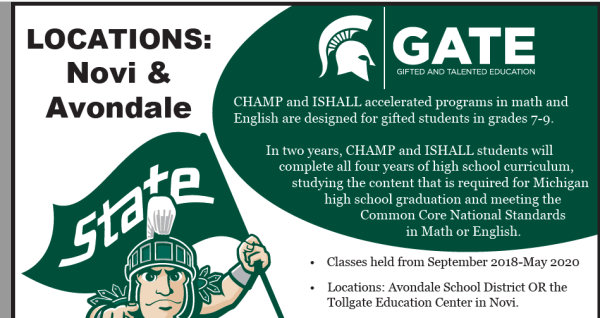
New to this area! Michigan State University’s acclaimed CHAMP and ISHALL accelerated programs in math and English allow gifted students to rapidly cover four years of high school curriculum in two! This accelerated program keeps their minds actively engaged in school and frees up school hours to take more electives of interest.
Check out this great program at CHAMP_and_ISHALL
Avondale Gifted Magnet Program Info Night

Does your child crave learning, but can’t get enough in the traditional classroom?
Having issues with boredom, spacing out, or acting up because he already knows the material or the pace is too slow?
Are you worried your child isn’t learning to work hard, overcome obstacles, or recover from failure?
The Avondale Gifted Magnet Program, open to students entering grades 2-5 in all of Michigan, may be the rescue your child needs!
These innovative classrooms use project-based learning to meet each child where they are and move them forward at their right pace. From helping Twice Exceptional students with their learning disabilities to providing instruction six years ahead in math, students receive the curriculum they need to be challenged and grow academically.
Built into the classroom culture are opportunities to develop the unique social and emotional characteristics of gifted children. In a classroom that values all, students respect each others’ different passions, abilities, quirks, and struggles. They find friends to share their interests with and learn about overcoming the pitfalls of perfectionism, disorganization, poor executive skills, and other challenges facing gifted individuals.
Attend Thursday, April 12, from 6:00 PM – 7:30 PM to learn about the program; talk to teachers, students, and parents; and tour the classrooms. There is no commitment in attending, but you can submit an application at the session.
Woodland Elementary is at 6465 Livernois Road in Troy, MI and the presentation will begin in the media center. This free school of choice program is open to students entering second through fifth that reside anywhere in Michigan. Application dates are from April 9 to May 9, 2018. For more information, see http://www.avondale.k12.mi.us/departments/gifted-and-talented
My child attends and I believe in this program!
Reminder: Avondale G/T School of Choice

Is your child in the top 5-7% of students and going into third or fourth grade next year? The great new gifted program in Avondale will provide the curriculum and instruction high ability students need!
Applications for the new Gifted Magnet Program in Avondale School District are due by 4 PM on Wednesday, May 10! More information on the program is at www.avondale.k12.mi.us/departments/gifted-and-talented and the School of Choice application is at chooseavondale.com Interested? Email Hillary Olance at hillary.olance@avondale.k12.mi.us
Thank you for reading Rochester SAGE! Together we are making a difference for gifted children!
Applying to Avondale Gifted Magnet Program

It’s that time! It’s the time that so many of us have been waiting for!
It is time to apply to the Avondale Gifted Magnet Program!
This fall, the Avondale Gifted Magnet Program launches third and fourth grade at Woodland Elementary in northern Troy. This program is open through School of Choice to students in Oakland County.
Using project-based learning, this program will provide a unique educational opportunity for gifted children. Students will be able to explore areas of interest in depth, discover the connection between subjects, and accelerate in their fields of strength. Surrounded by their gifted peers, they will receive acceptance and support for their academic, social, and emotional needs. This program is led by a teacher with an endorsement in gifted education and ten years of experience in teaching including three with gifted students. Backed by the support of the principal and the district, Avondale is committed to the success of this program and its students.
Registration for this program has already begun and goes through May 10. Details on this program are available at http://www.avondale.k12.mi.us/departments/gifted-and-talented and the School of Choice application and information is at http://www.avondaleschools.org/enrollment You can watch a recorded Parent Information Night at https://www.youtube.com/watch?v=jKmVqajZEqc or join our parent group at https://www.facebook.com/groups/NEOgifted/ to learn more.
If you are interested in this program for your child, please call Hillary Olance at 248.537.6049 or email her at hillary.olance@avondale.k12.mi.us by Friday, April 28 to get more information and schedule any tests for entrance to the program. Registration is still open until May 10, but early applicants get first choice of testing dates.
Please pass this along to friends whose children would benefit from this program!
Thank you for reading Rochester SAGE. Together we ARE making a difference for gifted children!
A path for gifted students

My first op-ed in the Detroit News!
“District policy doesn’t allow us to teach next year’s math. And it wouldn’t be fair to teachers to require them to be able to teach it.”
This statement by my daughter’s teacher exemplified the struggle we were having in the classroom, school and district. And it told us that except for the rare bright spot — like a principal dedicated to academic growth for all learners, but who went on sabbatical a year after we changed to her school, and a teacher who volunteered to teach sixth-grade math in a fifth-grade classroom — we would not be getting the services needed for our children.
More at http://www.detroitnews.com/story/opinion/2017/02/13/gifted-students-avondale/97871688/
Gifted articles you may have missed!
These past few months, many people avoided the insanity of the election, its news coverage, and the puerility on social media, but you may have also missed some great articles on giftedness! Here are a few hand-curated selections for you!
You can find additional interesting articles on the Rochester SAGE and Michigan Association for Gifted Children Facebook pages.
New Analysis Finds Two Measures Boost K-12 Academic Achievement
“After looking carefully at 100 years of research, it became clear that acceleration and most forms of ability grouping can be powerfully effective interventions,” said study co-author Matt Makel, research director at Duke TIP. “They help increase academic achievement for both lower- and higher-achieving students.
“Moreover, these practices can yield significant academic benefits without being expensive and can even save schools money.”
Getting Restless At The Head Of The Class
One day, a philanthropist asked one of Makel’s colleagues, Jonathan Plucker at Johns Hopkins’ Center for Talented Youth, what should have been a simple question, “How many students score above grade level on standardized tests each year?”
Makel and his co-authors found that, on the NWEA, 35 percent of beginning fifth-graders were already scoring at levels you might only expect by the end of the year. And, on the NAEP, the top 25 percent of fourth-graders outscored the bottom 25 percent of eighth-graders every year but one — for 26 years straight.
Dual enrollment grows in popularity, frustration
Dual enrollment has benefited thousands of Michigan students by giving them an early taste of college and, in many cases, allowed them to earn credits without paying tuition. But frustrations remain for students and families, who often find out later that the credits either aren’t accepted at the university they enroll in, or are counted only as general credits rather than applying toward a major.
Avondale School District prepares to launch classroom for gifted students
Avondale School District is getting ready to open the first gifted learning classroom in Oakland County next school year at Woodland Elementary in Troy.
The classroom will serve both third and fourth graders who are nominated and chosen for the program, with the nominations for Avondale students already closed. Between 25 and 28 students will be enrolled in the first year, working with their instructor and curriculum at their own pace and depth.
This is Us … Too: The Need for Gifted Education
I delight in the fact that the writers will introduce Randall as a gifted child in an upcoming episode. When I heard Randall cry, “I don’t want to be different,” my heart sank because he, at that moment, became every child I have ever taught as a gifted education teacher.
The need for gifted education programs in our public schools for children like Randall far surpasses the need for our gifted children to just be challenged academically.
We grade-skipped our daughter. Here’s why you should consider doing it, too.
“I want to do harder math,” she told us, and she didn’t want it delivered online. She asked to participate in small math groups with friends. But that alone wasn’t why my husband, Matt, and I chose to accelerate her. We also wanted to give her the gift of believing in herself.
Boredom, school, and the gifted child: Challenging its inevitability
No one ever promised fun and games, but the amount of time spent waiting, daydreaming, and battling boredom is even greater for gifted children. In the recesses of their memory, most gifted children recall the joy of learning, their innate curiosity, the spark of discovery when learning was neither slow nor tedious. But that experience may seem far removed from life in mixed ability classrooms tailored to the needs of the average or at-risk student.
Thank you for reading Rochester SAGE! Together we can make a difference for gifted children!
Avondale Gifted Magnet Information Nights!

Avondale is having two parent information nights regarding the gifted magnet school, available to Oakland County residents! Come find out about the magnet program and get your questions answered! The two nights are Dec 6 and Dec 13 at Woodland Elementary, the school hosting the program. The program will start in Fall 2017 for grades 3&4 and expand in the following years.
Please RSVP for one of the nights through the links below or to NEOgifted@outlook.com. Pass this information on to friends! They may be wondering how to meet the needs of their children and don’t know about this school.
December 6:
https://www.facebook.com/events/916601858470834/
December 13:
https://www.facebook.com/events/1717098978607552/

 Rochester SAGE - Supporting Advanced & Gifted Education