Together we can make a difference!
Never doubt that a small group of thoughtful, committed individuals can change the world; indeed it's the only thing that ever has. – Margaret Meade
We are looking for parents, teachers, and students who support advanced and gifted education for Rochester Community Schools in Michigan. Please subscribe to Rochester SAGE to receive updates.
Also, please visit the "How to Help" link in the upper right.
Twice Exceptional Children Overlooked
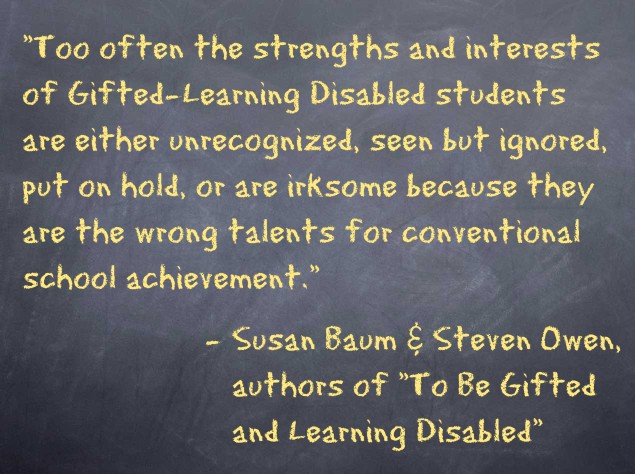
In a special post, guest blogger Amy Simko, co-leader of Gifted in Michigan, writes about Twice-Exceptional Learners
Twice exceptional refers to a person who is both gifted and learning disabled in one or more ways. Twice exceptional children are not often correctly identified in our schools and those who are discovered rarely have a place in school that provides what they need. Here’s an experiment for you…ask the next 10 people you meet what twice exceptional means. Chances are you’ll receive a few guesses and a lot of strange looks. Now that’s not so hard to believe, but now try asking 10 teachers what twice exceptional means. The result will not be so very different from the random sample. In fact, I’ve met medical professionals who had not heard the term before.
Funding cuts at our public schools have led to reduced resources, lower training budgets and fewer special programs. Teachers today are overwhelmed trying to meet the very different needs of children in their classrooms while working under limited allowances and goals of “teach to the test”. Few teachers, principals or administrators receive training to help them identify gifted children. When asked to identify gifted kids, many will select high achievers and those with good grades for consideration in gifted programs (if a gifted program exists).
Welcome to Rochester SAGE!
We just had over three hundred new subscribers join Rochester SAGE – Supporting Advanced & Gifted Education’s blog and Facebook page.
I wanted to thank all of you who read, shared, commented, or reblogged some of my posts. I was pleasantly astounded when my phone buzzed with notifications for three days straight!
Rochester SAGE is a group of parents in Rochester and Rochester Hills, Michigan advocating for gifted education in Rochester Community Schools. My name is Joshua Raymond and I am the founder and lead advocate. I also author most of these blog posts, with occasional contributions by other members of Rochester SAGE.
My usual topic is gifted education. I try to keep current with gifted education news, programs, philosophies, myths, objections, and issues and then pass the information along to inform and help your advocacy for gifted learners. I’ve covered a number of topics, but if you have an idea on something I should write on, please leave a comment or contact me. Or write about it and let me know, so I can reblog it or include it in my monthly Spotlight on Giftedness.
Other posts are centered on Michigan’s Rochester Community Schools specifically. These may not be of interest to my readers from other cities, states, and countries, but are an important part of my mission to increase options for gifted students in our local schools and to ensure that RCS always strives for the best education for all children.
You may not find every post aimed at you, but I hope you will join the dialogue as we draw attention to the needs of gifted learners.
Thank you for reading Rochester SAGE! Together we can make a difference for gifted students!
I Want My Kids to Fail
I’ve missed more than 9000 shots in my career. I’ve lost almost 300 games. 26 times, I’ve been trusted to take the game winning shot and missed. I’ve failed over and over and over again in my life. And that is why I succeed. – Michael Jordan
The pupil who is never required to do what he cannot do, never does what he can do. – John Stuart Mill
I want my kids to fail. That probably isn’t at the top of your list for your kids, but it should be. Failure is one of the most important experiences they will ever have. The road to success is paved with failure because failure teaches us how to succeed. Read more…
Data and Interventions at RCS Study Session tonight
Tonight the Rochester Community Schools Board of Education will be discussing using data to drive interventions for students. Theoretically, our Pyramid of Intervention was meet the needs of both struggling and advanced students. Will you join me tonight in making sure that advanced and gifted students are not left out of this important discussion?
Where: Rochester Community Schools Administration Building, Parker Room (upstairs)
When: Monday, February 27, 2012, immediately following the regular 7:00 PM board meeting
This study session will not be televised, but is open to the public.
An example Pyramid of Intervention is below:

Thank you for reading Rochester SAGE! Together we can make a difference for advanced & gifted students!
RCS 2011 MEAP by School
Listed below are the MEAP scores by grade and subject for each elementary and middle school in Rochester Community Schools. The “Met” column is the percentage for each grade that passed, either as proficient or advanced. The “Adv” column is the percentage that were categorized as advanced.
Read more…
MEAP: Rochester vs. State and Top Districts
The MEAP results were made public today. Rochester Patch ran a comparison of average MEAP scores between Rochester Community Schools (RCS) and the state of Michigan. The good news was that we still ranked highly. The bad news is that we trended down. My initial thought was that perhaps the top schools had trended down while the bottom schools trended up, but I needed to run the data.
I also compared Rochester Community Schools to the top 17 districts in the state. In there are three charter schools, which I left in since charter schools are becoming a greater competition for traditional public schools. No private or parochial schools are included. The districts are Achieve Charter Academy, Ann Arbor Public Schools, Birmingham City School District, Bloomfield Hills School District, Canton Charter Academy, East Grand Rapids Public Schools, Forest Hills Public Schools, Glen Lake Community Schools, Haslett Public Schools, Northville Public Schools, Novi Community School District, Okemos Public Schools, Rochester Community School District, Saline Area Schools, South Arbor Charter Academy, South Lyon Community Schools, and Troy School District. These districts were chosen for averaging above 65% proficient in last year’s MEAP using the new cut scores. RCS ranked only behind Canton Charter Academy.
The results were interesting.
Read more…
The Soft Bigotry of Low Expectations
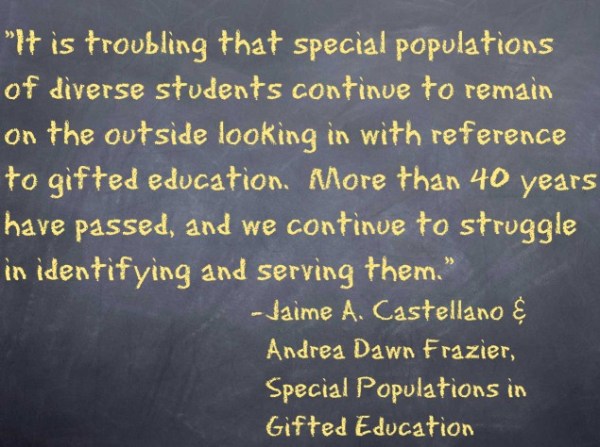
“While parents of all children who are not in the mainstream do not have an easy time in our society, the fact that 2e children’s disabilities mask their giftedness, and their giftedness masks their disabilities, makes it incredibly hard to get the “experts” to listen and to understand that you can’t just average the two and say this is an average child.” − Joan Affenit
“As we strive to close the achievement gaps between racial and economic groups, we will not succeed if our highest-performing students from lower-income families continue to slip through the cracks. Our failure to help them fulfill their demonstrated potential has significant implications for the social mobility of America’s lower-income families and the strength of our economy and society as a whole.” – Joshua Wyner, Achievement Trap
“The soft bigotry of low expectations” This famous line of President George W. Bush supporting the passage of No Child Left Behind resounds today as states still struggle to get every school and every child to meet minimum academic standards. But as states strive to improve urban schools, I have to wonder if the government cares that one group of students is still being left behind due to low expectations. Why are gifted minority, low-income, and learning disabled students still being overlooked?
Spotlight on Giftedness – January 2012
A collection of news articles regarding gifted children and education for January 2012.
This month I wanted to highlight a brief article about a subset of gifted children – twice-exceptional (2E) kids. These children are as much a part of the part of the gifted community as any other gifted child but often get overlooked because of their learning disabilities. Rifka Schonfeld’s article Twice Exceptional: One Child, Two Special Needs gives a short glimpse about who these children are and what can be done to help.
The term “twice exceptional” is still new in educational jargon, but it is becoming more prevalent in my practice today. Twice exceptional children have a combination of exceptional intellectual power and uncommonly formidable mental roadblocks. That is, twice exceptional children are gifted intellectually and also can have Attention Deficit Hyperactivity Disorder (ADHD), Aspergers Syndrome, Nonverbal Learning Disorder (NVLD), or dyslexia.
Research suggests that these children are the most underserved populations in the school system. Most of the time, children who are twice exceptional go through school without recognition of their considerable talents. Instead, they enter adult life without the necessary skills to compensate for their learning disabilities. Many of these children develop low self-esteem and believe that they are simply stupid and “not good at school.” Shockingly, the US Department of Education estimates that 2–5 percent of all students are both gifted intellectually and suffer from some form of learning disability.
I know some of my readers have twice-exceptional children. I would be interested to hear what your experience has been with schools and the gifted community.
Many more great articles are provided in the links below! 
Read more…
Spotlight on Giftedness – December 2011
A collection of news articles regarding gifted children and education for December 2011.
December had fewer articles, but there were some real gems, including a two-part article on how many traits of gifted individuals are both positive and negative. There is also an interview with Professor Miraca Gross on structuring a school by ability instead of age.
This month’s featured article is about differentiated instruction. This appears to be the instructional fad sweeping the schools right now as a means of meeting the needs of all students, from struggling to gifted, in the standard classroom. The promises are outstanding, but the results often are not. Jeffrey Bennett explains why in his article Differentiated Instruction: Easier in Theory than in Practice:
The idea behind Differentiated Instruction is beautiful: instead of teachers teaching to the mean of the whole class, teachers “meet children where they are,” and teach all children based on their individual pre-existing skills or learning styles. It’s a theory that holds promise for low-achievers who need more structure and basics and for high-achievers, who need that push and enrichment to reach deeper conceptual knowledge. The concept itself is so attractive that it’s hard to imagine anyone disagreeing with it. In fact, despite the criticisms of Differentiated Instruction that are about to come, I still support it as one of the many tools schools should use to reach students. In elementary schools where leveling is philosophically unpalatable, I think Differentiated Instruction is more than good, it is absolutely necessary as the best method we have of educating students of varying readiness.
My critique is that Differentiated Instruction is no substitute for upward-pushing leveled classes. Even in the writings of Differentiated Instruction main theorists it is not supposed to be a stand-in for in-class leveling. In practice Differentiated Instruction is so time consuming for teachers that they often are unable to do it. My belief is that there is no either/or between differentiation and leveling and using the two in combination is ideal for that ideal “thorough and efficient” education.
…
Surveys of teachers show ambivalence about Differentiated Instruction. Although many teachers use Differentiated Instruction enthusiastically, a greater number have issues with it. A 2008 nationwide survey of 900 teachers by the Fordham Institute, over 80% said Differentiated Instruction was “very difficult” or “somewhat difficult” to implement. A very high 76% of teachers would like to see the nation “relying more on homogeneous classes for advanced students so that they learn faster and in greater depth.”
Read the entire article at Patch.
Many more great articles are provided in the links below!
Read more…
The Procrustean Bed of Education

Grouping kids by age for instruction makes about as much pedagogical sense as grouping them by height! – Dr. Deborah Ruf, founder of Educational Options
Since the literature demonstrates the value of grouping students by ability, while few if any studies support restricting grouping to common ages, it is ironic that so many schools are moving from the former to the latter. – Mike Robison, “One size fits all?”
In Greek mythology the hero Theseus in his journeys meets a stranger Procrustes who offers him hospitality, including the use of his wonderful bed which ‘fits every guest and cures him of every ill.’ While Procrustes is preparing the bed for Theseus, Procrustes’s servant girl warns Theseus about this bed and why Procrustes is called the Stretcher.
“Did he not tell you that it fits all guests?” said the girl; “and most truly it does fit them. For if a traveler is too long, Procrustes hews off his legs until he is of the right length; but if he is too short, as is the case with most guests, then he stretches his limbs and body with ropes until he is long enough. It is for this reason that men call him the Stretcher.”
Our educational system has become a Procrustean Bed, not measured in inches but in proficiency. The state and federal governments along with the school districts have provided a measure to which some students are stretched and others are not allowed to exceed.
Read more…

 Rochester SAGE - Supporting Advanced & Gifted Education